
Photo by John Bernard
By Kaiya Little
Editorial Fellow, Audubon Magazine
Published February 05, 2026
If there’s a House Wren near your home, chances are you’ll hear it before you see it. And when you do get a look at one, it might be hard to believe something so small can cause such a ruckus.
On top of their near-constant singing, these teensy songbirds’ territorial behaviors make them even harder to miss. In 2024, scientists split the House Wren into seven species. Of the bunch, six can only be found in the tropics, but the Northern House Wren is a common guest around North American homes from coast to coast. Read on to learn more about one of our noisiest neighbors.
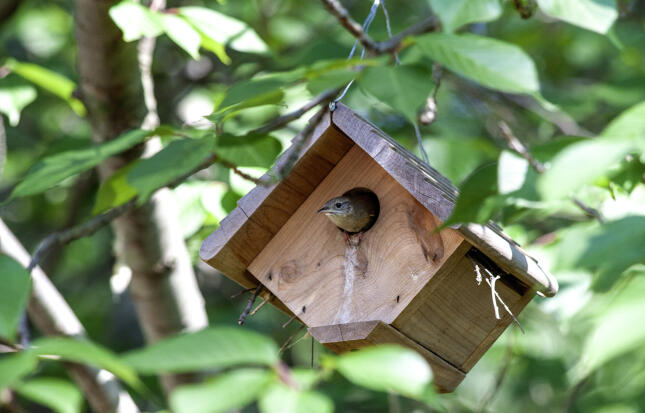
1. Northern House Wrens are cavity nesters—meaning they lay their eggs within holes in trees—but they’ll make a home out of just about anything. Unlike woodpeckers and other birds that excavate their own nest sites, wrens will locate an existing nook or cranny and make it home with a variety of materials like animal hair and plant fibers. Wren real estate can range from nest boxes and tree hollows to more unusual structures like drainpipes, shoes, and cans. Pretty much any enclosed space is an attractive option to them.
2. Despite their petite stature—they weigh roughly as much as two quarters!—Northern House Wrens are fearless and brutal in their pursuit of nesting sites. To take over a nesting cavity, they often puncture holes in other birds’ eggs and sometimes kill their nestlings. In fact, attacks from Northern House Wrens are among the top causes of nest failure for some birds, including bluebirds and chickadees. This behavior led ornithologist Althea Sherman to compare the House Wren to a “felon” guilty of “nefarious activities” in a 1925 edition of the Wilson Bulletin. Today’s ornithologists typically avoid such human-based judgment of a bird’s natural instincts.
3. The House Wren’s scientific name—Troglodytes aedon—also points to this behavior. The name translates to “cave-dwelling nightingale,” a reference both to their nesting in holes and to the Greek myth of Aedön, a queen of Thebes who, in a tragic twist of fate, accidentally killed her own son when trying to murder a rival’s child. To spare her from grief and end the chaos, Zeus transformed Aedön into a nightingale, who forever sings in lament.
8. Because of all this incessant chatter, the Cherokee consider Northern House Wrens messengers of the bird world. The Ganulatsi (gah-nu-la-jee), also written as ᎦᏄᎳᏥ using the Cherokee Syllabary, are thought to carry news of babies being born in the community. From their nesting spots around the home, elders say the House Wren could keep an eye on all the comings and goings.
9. As their name suggests, House Wrens are some of the most human-tolerant birds and are accustomed to living among us. People across the United States and beyond get the pleasure of having these feisty charmers as neighbors: In the non-breeding season Northern House Wrens take up residence in communities across the southern United States and into Mexico. When nesting season approaches, they return to northern suburbs, parks, and woodlands to breed across every state, with the exceptions of Alaska and Hawaii.
10. You wouldn’t know it now, but in some parts of their range, House Wrens were in decline due to competition for nest sites from the similarly named but non-native House Sparrow. Today, however, the Northern House Wren population is actually increasing while many other common birds are declining, and the International Union for Conservation of Nature considers it a species of least concern.